
What Is an Anti-Riot Cage?
Release time:
2026-11-03
What Is an Anti-Riot Cage? A Complete Guide to HESCO-Style BarriersAn anti-riot cage — often called a HESCO-style barrier, gabion barrier or blast wall — is a collapsible rectangular box made of welded steel wire mesh. It arrives flat-packed, unfolds on site, is lined with a nonwoven geotextile fa
What Is an Anti-Riot Cage? A Complete Guide to HESCO-Style Barriers
An anti-riot cage — often called a HESCO-style barrier, gabion barrier or blast wall — is a collapsible rectangular box made of welded steel wire mesh. It arrives flat-packed, unfolds on site, is lined with a nonwoven geotextile fabric, and is then filled with sand, soil or gravel using a loader or excavator.
Because the fill material comes from the ground at the site, these barriers can be deployed in hours instead of weeks — no concrete, no curing time, no heavy foundation.
H2: How an Anti-Riot Cage Is Built
Four components determine performance:
Welded mesh panels — typically 3 mm to 5 mm galvanized steel wire, welded into a rigid grid. The weld (not weaving) is what gives the cage its resistance to impact and burst pressure.
Joint and spiral binding — panels are connected with heavy spiral coils, allowing the unit to fold flat for shipping and unfold without tools.
Geotextile liner — a heavy-duty nonwoven fabric stitched into the cage. This is the critical part: the liner retains fine soil particles so water cannot wash the fill out, which is why the same cage works for both flood defence and blast mitigation.
Fill material — sand, crushed stone, gravel or onsite soil. A standard unit holds roughly 1 tonne of fill.
H2: What Are Anti-Riot Cages Used For?
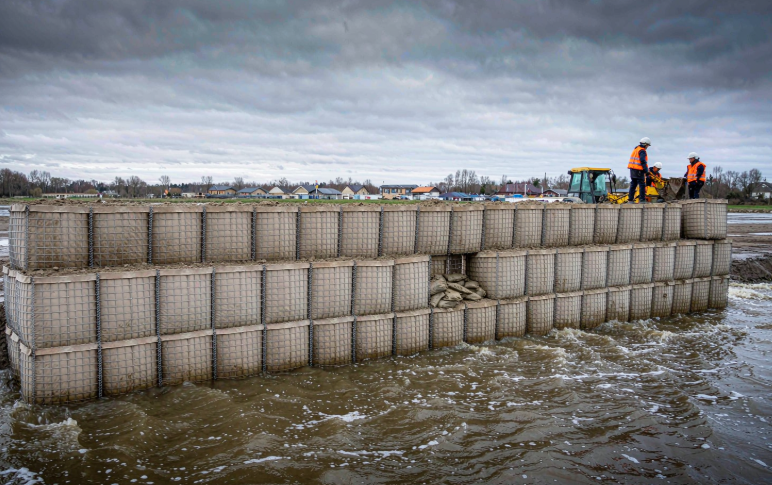
Flood control and emergency dykesStacked two to three layers high along riverbanks, roads and urban low points. Because deployment needs only a loader and local sand, they are the standard rapid-response solution during flood season.
Blast mitigation and military protectionSand-filled mesh walls absorb and disperse blast pressure and fragment energy. Used around checkpoints, ammunition storage, forward operating bases and critical infrastructure.
Perimeter security and crowd controlForms temporary or semi-permanent barriers around events, construction sites, borders and restricted zones — faster to install than fencing and far harder to breach.
Erosion control and retaining wallsThe geotextile liner allows water to drain while holding soil in place, making the units effective for embankment stabilisation and channel lining
H2: Why Source From a Welded Mesh Manufacturer
Anti-riot cages are, at their core, a welded wire mesh product. Buying direct from a mesh factory rather than a trading company gives you:
- Control over wire diameter and zinc coating — the two factors that decide service life
- Custom panel sizes, mesh openings and liner weights
- Consistent weld strength, tested per batch
- Factory-direct pricing on container volumes
- OEM branding and custom packaging
H2: FAQ
How long does it take to install an anti-riot cage?
A trained crew with a loader can fill and stack 20–30 units per hour. A 100-metre, 2-metre-high wall is typically completed in one working day.
Can the cages be reused?
Yes. Units can be emptied, folded flat and relocated. The geotextile liner is usually replaced on redeployment.
Do they work in saltwater or coastal environments?
Yes, provided the mesh is hot-dip galvanized to at least 240 g/m² or Galfan coated. Standard galvanized mesh is not suitable for permanent seawater immersion.
What fill material should be used?
Sand, crushed stone or gravel with particle size smaller than the mesh opening. Avoid organic soil and clay-heavy fill, which loses strength when saturated.
What is the minimum order quantity?
Standard stock sizes ship from 1 × 20GP container; custom sizes typically require 500 units.
related news
2026-08-27
2026-11-03